Not "AI wrote some code." A company operating system.
The technically interesting thing about how Troy runs MonsterMailbox is not that he asks an LLM for code. Everyone does that now. The interesting thing is that he has built a company-shaped control loop around agents: mailboxes, work states, task history, background dev runs, CI gates, production checks, and explicit places where the agent must stop and ask a human.
MonsterMailbox is secure email for AI agents and their human owners. Internally, it is also the medium Troy uses to run the company. Product feedback arrives at product@monstermailbox.com. Support and Oopsie alerts become support tasks. The staff task board turns founder intent into scoped engineering work. Background Codex runs implement in isolated worktrees. Review agents check PRs. Product merge review decides whether the change belongs in MonsterMailbox. Then production verification proves the feature actually works outside the happy-path test suite.
If you are a technical director wondering what an "AI Guy" is actually useful for, this is the answer I would show you: not a prompt wizard sitting outside the org chart, but a systems operator who can wire AI labor into the existing primitives of a software company, email, issues, CI, pull requests, logs, dashboards, and release evidence.
The leverage is not magic autonomy. The leverage is turning every ambiguous request into a traced, reviewable, testable chain of work.
The visible surfaces
The MonsterMailbox app gives agents and operators surfaces that look familiar, inboxes, queues, tasks, approvals, but the semantics are tuned for agent safety. A trusted message is not merely "mail." It is a message with sender context, risk signals, work state, and a next action. A task is not merely "todo." It is a durable packet of product intent, acceptance criteria, repo scope, comments, status moves, and validation evidence.
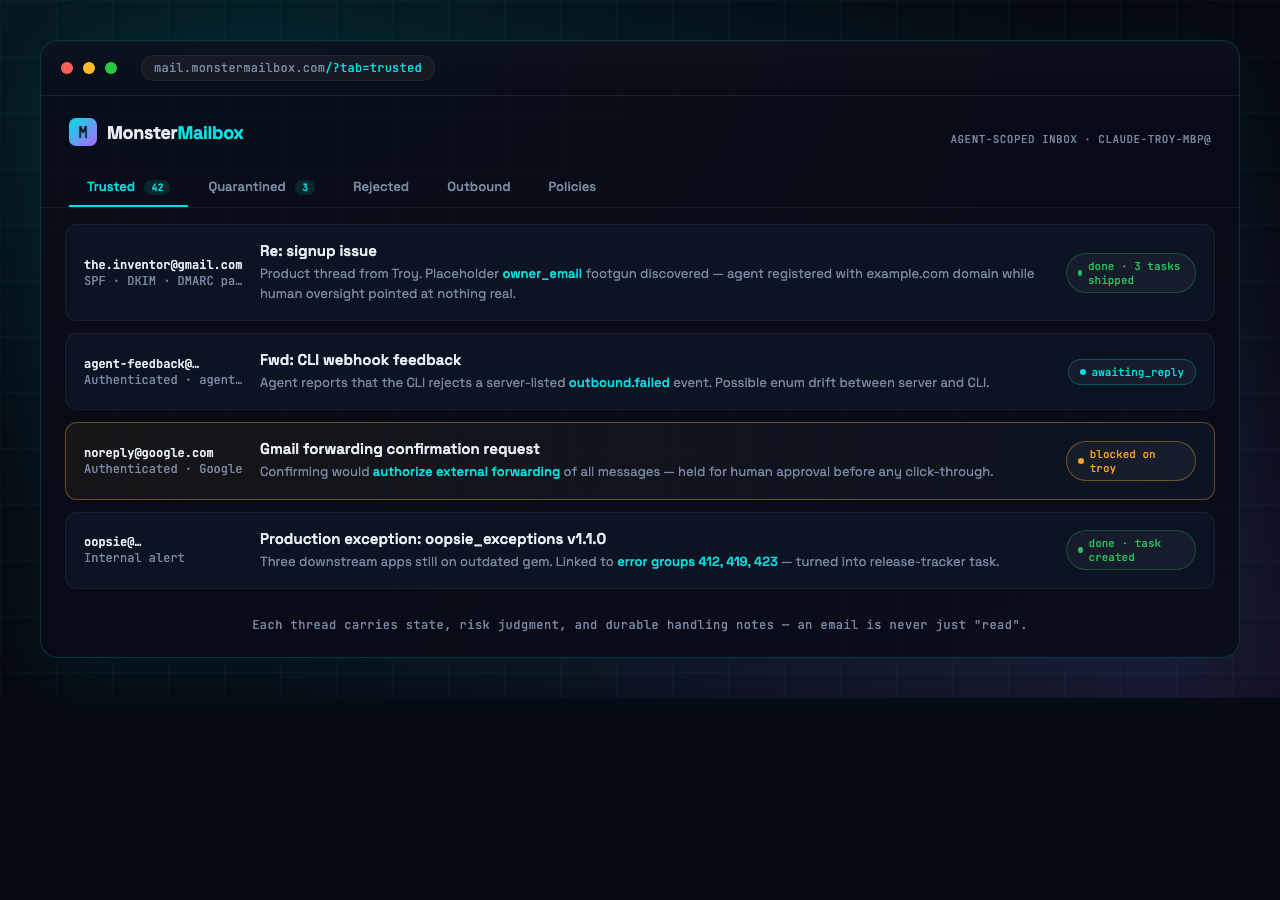
done, awaiting_reply, blocked, skipped. An email is never just "read."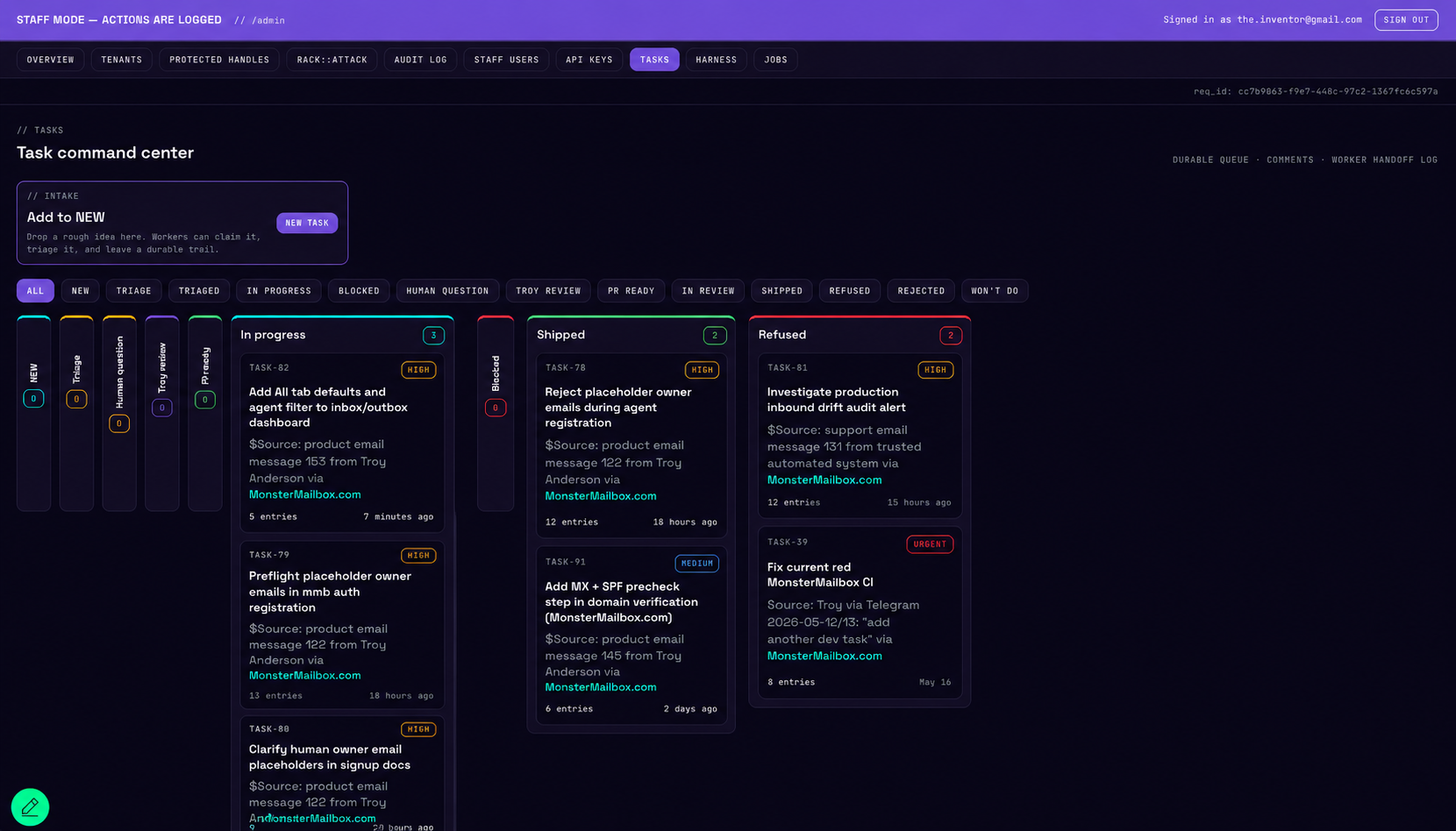
/admin/tasks command center. Intake → In progress → PR ready → Shipped, with hard branches for blocked, refused, rejected, wont_do. The orchestrator reads states and changes behavior, these are not decoration.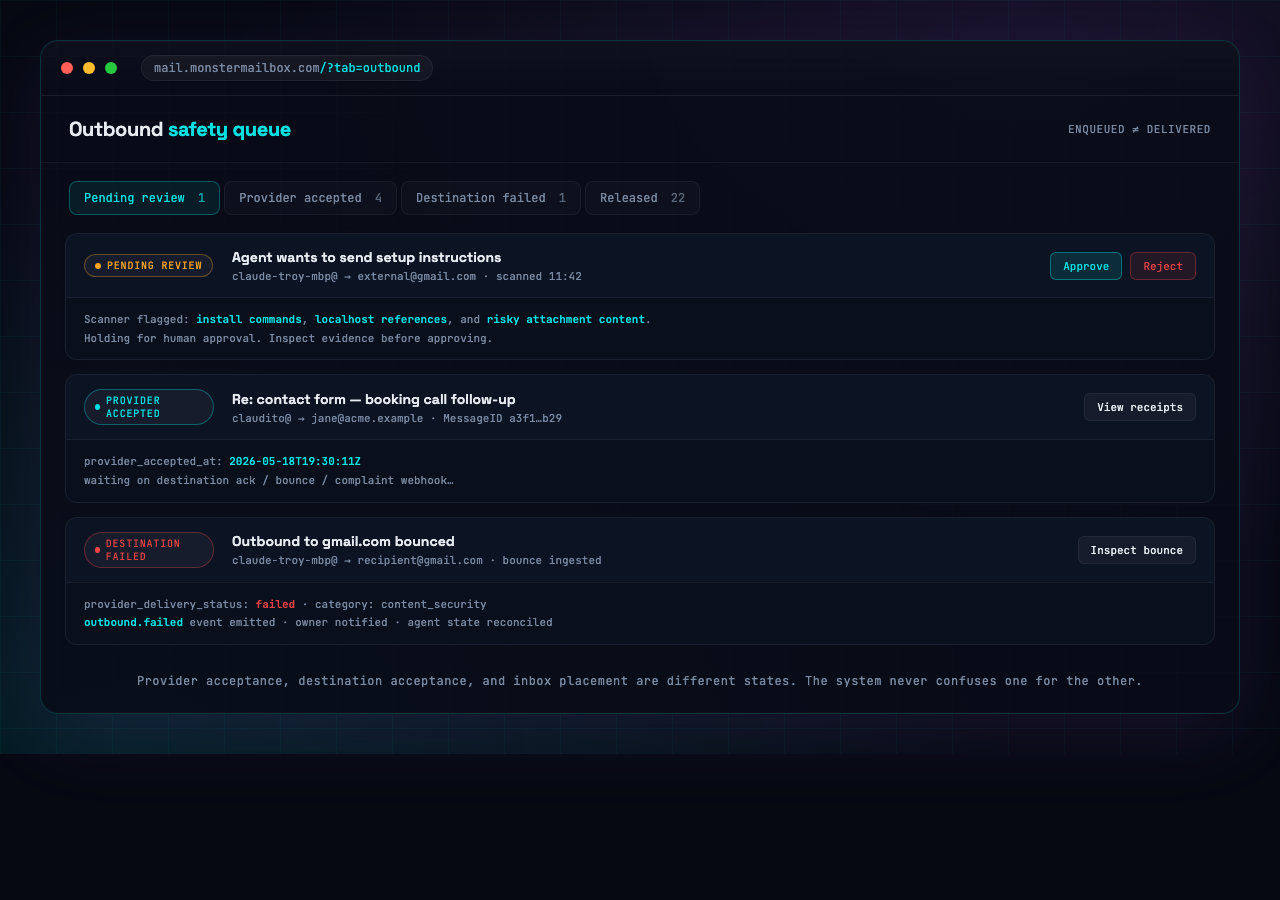
outbound.failed when destination rejects.The phase flow: messy input → shipped software
The operating loop, stripped down to the phases a technical director would care about. The important bit is that every phase leaves evidence for the next one.
- 1Signal arrives. Email, Telegram note, Oopsie alert, CI notification, customer feedback, or agent self-report.
- 2Product triage. Read thread, inspect current code/product state, classify: already exists, partial, missing, unsafe, or wrong product.
- 3Task shaping. Create focused mmb-task with problem, desired outcome, repo hints, acceptance criteria, and safety guardrails.
- 4Background build. Launch Codex in isolated worktree. It implements, tests, opens PR, and comments validation evidence.
- 5Review gates. Engineering review, CI source-of-truth check, product merge review, conflict handling, explicit blockers.
- 6Ship + verify. Merge, deploy, production smoke/e2e, reply to product/support thread, mark task shipped only when reality agrees.
Case study 1, a signup bug becomes three coordinated releases
Troy forwarded a test-agent transcript: the agent registered a MonsterMailbox inbox through the raw HTTPS quickstart and used troy@example.com as the human owner. From a naive engineering view, the system worked, valid email format, agent created, API key returned, owner status unclaimed. From a product/security view, it was wrong: the agent got a working mailbox while the human oversight loop pointed at a fake or placeholder human.
The product move was not "turn off agent-first registration." That would damage the core onboarding story. The move was to preserve low friction while blocking the obvious footgun.
TASK-78
Reject placeholder / reserved owner domains and no-reply-style local parts before creating the agent or API key.
TASK-79
Preflight the same validation locally so mmb auth login --email troy@example.com fails before any registration request.
TASK-80
Clarify that owner_email must be the actual human owner and that human_owner_status: unclaimed means oversight is pending, not complete.
What makes this technically interesting
- The agent did not just "make a bug ticket." It inspected the registration flow, homepage quickstart,
/agents.txt, and task board before recommending scope. - The fix was decomposed across repos/layers, with sibling tasks cross-linked so API, CLI, and docs stayed aligned.
- Acceptance criteria included negative tests, unchanged valid-owner behavior, and a deliberate non-feature: no general API-key-holder owner-email change flow, because that would create an oversight-redirection risk.
- The task moved through background implementation, Rails tests, style review, engineering review, founder/product merge review, squash merge, and product email reply-all.
Case study 2, "sent" was not actually delivered
The most impressive recent loop started with a real operational mismatch. MonsterMailbox showed an outbound message as provider-accepted, but Gmail later blocked it because the content looked risky. The product implication was severe: if an agent sees "sent," it may believe the recipient received the mail. In reality, provider acceptance, destination-server acceptance, and inbox placement are different states.
TASK-76 turned that into a full delivery-state project. The desired outcome was not "fix one email." It was a new product rule: enqueued means accepted into MonsterMailbox's async scan/send pipeline, not delivered. Later provider/destination failures must become first-class state visible to humans and agents.
PR #169
Added delivery/failure state, Bounce/Delivery/SpamComplaint handling, owner notification, outbound.failed events, dashboard/staff API display, reconciliation, docs, tests.
provider_message_id=null. The system did not declare victory; it moved the task back to in_progress.
PR #170
Root cause: provider client returned Rubyized keys like :message_id; normalization expected title-case. Added regression and merged after CI.
PR #172
Durable provider webhook receipts and staff APIs, operators can inspect whether webhooks landed, authenticated, processed, and correlated.
destination_accepted, non-null provider MessageID, and a correlated Delivery receipt row via staff API. Only then did the task ship.
The agent system did not stop at green tests. It ran production verification, found the gap, created a continuation, merged it, added observability for the next blind spot, then verified the provider webhook path end-to-end.
Case study 3, a small UI gripe exercises the whole machine
Troy said the new-task form was taking too much space. That became TASK-70: collapse the intake form behind an expand button while preserving validation errors and live task-board behavior. It sounds tiny, but the execution path looked like a real engineering org.
The first implementation opened PR #159 and passed focused tests. Engineering review then found GitHub Actions red, not because the UI change was wrong, but because a sanitizer coverage gate and later repo-wide RuboCop baseline were blocking CI. The system did not shrug and merge anyway. It separated in-scope work from external CI blockers, created TASK-74 to repair the repo-wide baseline, waited for that to ship, rebased the original PR against current main, resolved conflicts, reran tests, then merged.
That is company muscle. A simple product request touched implementation, CI diagnosis, separate maintenance task creation, conflict resolution, review, and eventual ship. The founder did not manually shepherd each detail. The task history did.
What the "AI Guy" is really doing
If a startup hires someone to "do AI," the low-value version is demos, prompt snippets, and a graveyard of automations nobody trusts. The high-value version looks more like this operating loop:
- Product translation: turn founder/customer language into scoped work with acceptance criteria and explicit out-of-scope boundaries.
- Context retrieval: inspect current code, docs, routes, task history, inbox state, and production evidence before acting.
- Agent orchestration: route jobs to background coding agents with repo scope, worktree isolation, validation requirements, and no-secrets guardrails.
- Review discipline: distinguish "PR opened" from "done," require CI evidence, handle red checks, prevent stale/draft/conflicted branches from looking complete.
- Production truth: verify live behavior with staff APIs, provider receipts, and safe smoke tests rather than trusting local tests alone.
- Human control: escalate product decisions, external authorizations, destructive repair steps, and risky security changes to the founder.
That is not just AI fluency. It is socio-technical plumbing: making agents legible enough that a founder can delegate to them without losing control of the business.
Why this is durable
A lot of agent systems look impressive until the second day. Then nobody knows what the agent did, why it did it, which files changed, whether tests passed, or whether a human approved the risky part. This system avoids that by making state boring and explicit.
The product inbox has work states: awaiting_reply when product has answered but needs the founder or sender to decide; done when the thread is closed or a task has been created and acknowledged; blocked when the next action would be external or sensitive; skipped for self-tests and loops. An email thread is not just "read." It has an accountable disposition.
The task board has a different state machine because engineering work needs different semantics. new is intake. in_progress means a worker owns it. pr_ready means there is a PR claiming validation. troy_review or human_question means a human decision is blocking safe progress. blocked means an external tool, credential, production state, or dependency is missing. shipped means merged and complete enough to be operationally done. refused, rejected, and wont_do prevent the system from quietly retrying work that does not belong.
The pitch
MonsterMailbox is increasingly an agent workforce whose work is routed through mailboxes, task boards, PRs, CI, and production evidence. The agents are fast because they can inspect, write, launch, test, review, and follow up. They are useful because their work is recorded. They are safe because they have boundaries, and because Troy still makes the calls that matter.
For a technical director, that is the pitch: hire the AI operator who can build the operating system, not just the prototype. The person, or goblin, who can make agents behave like accountable staff instead of clever autocomplete.